

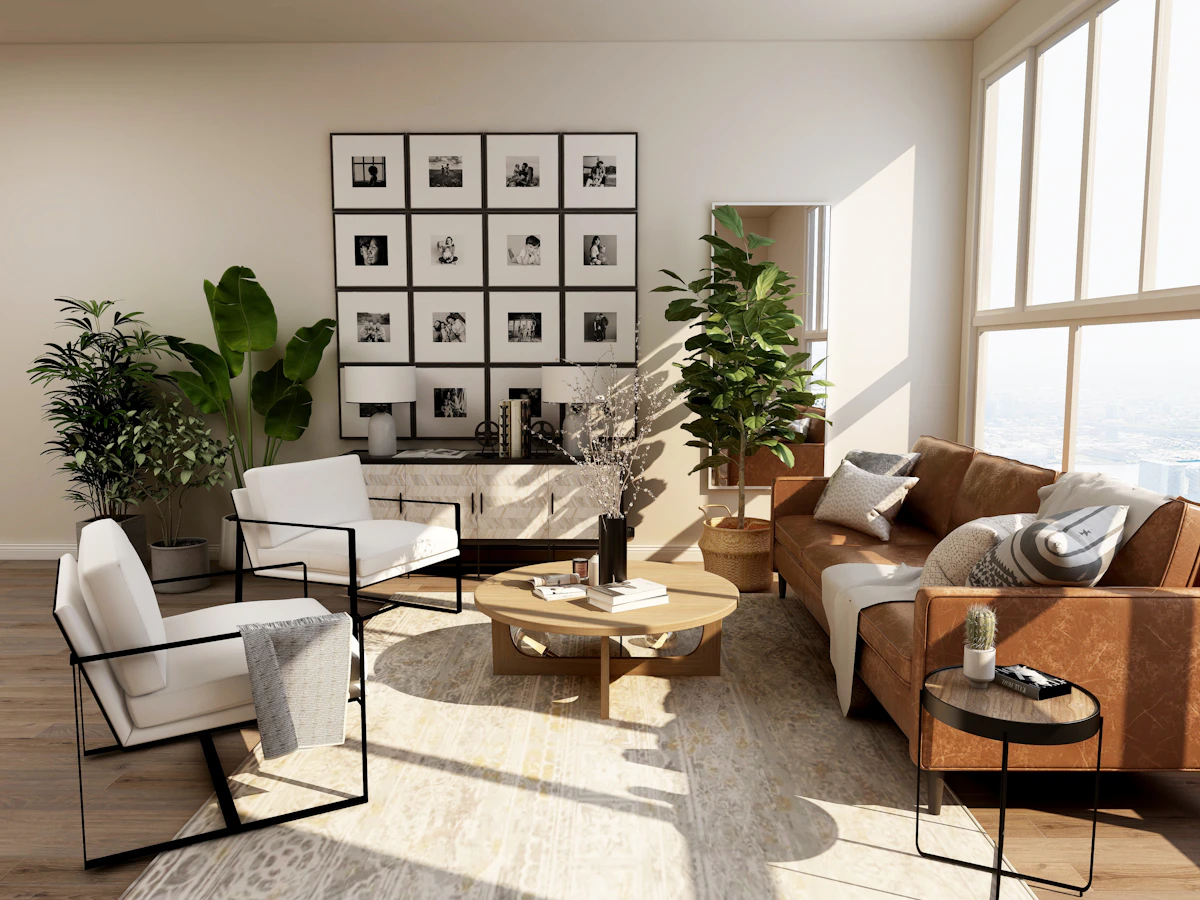
From warm minimalism to biophilic layouts built for our humidity, here's what's actually showing up in Dhaka living rooms this year — not just moodboards.
Warm minimalism replaces cold minimalism
Clients still ask for "simple" and "clean," but almost none of them mean stark white boxes anymore. What we're actually building is warm minimalism — pared-back layouts with fewer, better pieces, softened by timber tones, textured lime plaster, and layered warm-white lighting instead of a single cool-white ceiling light.
The difference sounds subtle on paper but it's obvious the moment you walk into the finished room: it feels calm rather than clinical, and it photographs beautifully without looking like a showroom nobody actually lives in.
Furniture that earns its square footage
Apartment sizes in Gulshan, Banani, and Bashundhara haven't grown, but expectations have — a study nook, a proper dining table, guest sleeping space, all in the same footprint. So furniture is being asked to multi-task: storage beds, extendable dining tables, modular sofas that split into two, console tables that fold out for guests.
We now design the furniture layout alongside the civil work, not after it, so built-in storage and multi-use pieces are planned into the walls and joinery from day one instead of squeezed in later.
Indoor greenery, adapted for humidity
Biophilic design — bringing plants and natural texture indoors — is one of the most requested looks this year. The trap is copying a Pinterest layout built for a dry climate and watching it struggle through a Dhaka monsoon.
We place greenery where airflow is actually good, use raised planters instead of direct floor contact near walls, and choose species that genuinely tolerate our humidity, so the "jungle corner" still looks intentional in August, not just in the after-photos.
A return to local craft
More clients are asking us to move away from the imported flat-pack look and lean into cane, teak, terracotta, and handloom textiles sourced locally. It's partly cost-driven, but mostly aesthetic — these materials age well in our climate and give a space a character that a shipped-in catalogue piece never quite has.
A cane pendant light or a teak console with proper joinery reads as more considered than an imported piece twice its price, and it supports local craftsmanship in the process.

Layered lighting, not a single ceiling point
The single center ceiling light is on its way out. In its place: ambient lighting for general use, task lighting over counters and desks, and accent lighting on art, alcoves, or a textured wall — each on its own circuit so the mood of a room can change from morning to evening without moving a single piece of furniture.
Ceilings treated as a design surface
Exposed beams, coffered false-ceiling panels, and cove lighting are showing up in almost every living room brief we get this year. Clients are done with a flat, ignored ceiling — it's being treated as a fifth wall, with its own material and lighting plan.
Personal galleries over generic art
The generic framed print above the sofa is being replaced by curated, personal walls — family photographs, a parent's old artwork, travel finds, arranged with real gallery spacing and consistent framing. It costs little more than a set of matching prints and makes a space unmistakably someone's own.
Key Takeaways
- ✓ Warm materials and layered lighting are replacing stark, all-white minimalism.
- ✓ Furniture is being chosen — and built-in — for multi-use, not just looks.
- ✓ Greenery and local materials need to be chosen for Dhaka's humidity, not copied from a dry-climate moodboard.
- ✓ Ceilings and personal walls are two of the easiest places to add character without a full renovation.
Let's Talk
Ready to bring this to your own space?
Book a free consultation and we'll walk through what's possible for your home or office — no obligation.